Australian UV levels are among the highest in the world. Between September and March, the UV index regularly hits 11+ across most capital cities — well into the “extreme” category. A shade sail is one of the fastest, most affordable ways to make your backyard genuinely usable during those months.
This guide covers everything you need to pick the right sail for your space: shapes, fabrics, UV ratings, sizing, installation methods, Australian costs, council rules, and maintenance. If you are still planning your outdoor space from scratch, start with our backyard landscaping ideas for Australia — shade comes after you know your zones.
01.Shade Sail Shapes: Triangle, Rectangle, or Overlapping
The shape you choose affects coverage area, visual weight, and how the sail handles wind.
Triangle shade sails are the most common residential shape. They suit small patios, pool areas, and corners where a rectangle would overhang awkwardly. A single equilateral triangle (say 5m x 5m x 5m) covers roughly 10-11 sqm of usable shade — enough for a small dining setting. The downside: triangles leave gaps at the edges, and one sail rarely covers a full entertaining area.
Rectangle and square sails cover more ground per sail. A 4m x 6m rectangle gives you 24 sqm of shade with fewer gaps. They work well over decks, outdoor entertaining spaces, and carports. The trade-off is that rectangles catch more wind and need stronger fixing points and heavier-gauge steel posts.
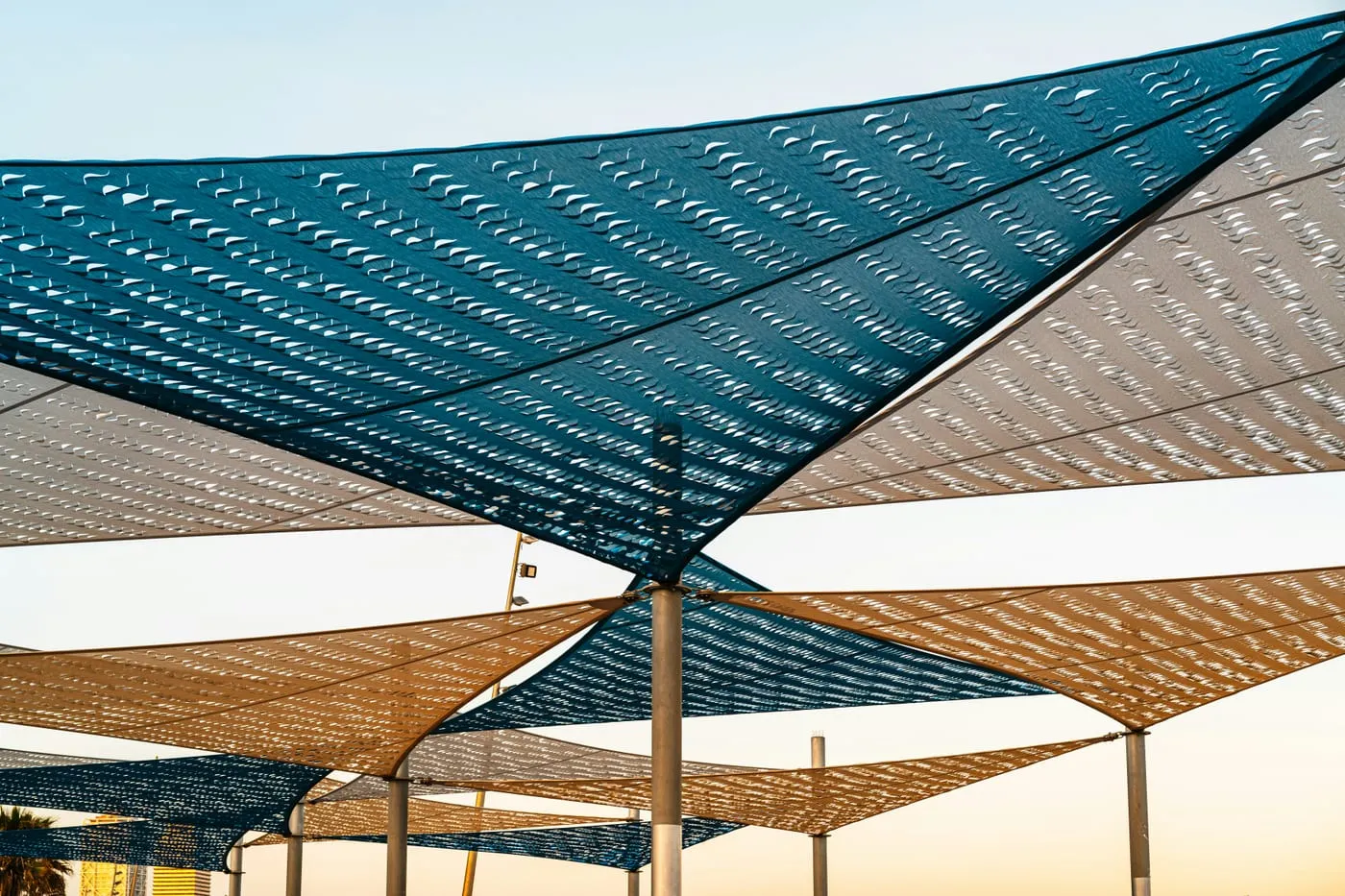
Overlapping sails are where shade design gets interesting. Two or three triangles at different heights and angles create layered coverage with better airflow, more visual depth, and improved wind performance compared to one large rectangle. Overlapping also lets you mix colours — a darker sail over the cooking area and a lighter one over the dining table, for instance.
Which shape to pick:
- Small courtyard or pool corner → single triangle
- Full deck or patio → rectangle or two overlapping triangles
- Large entertaining area → three overlapping sails at varying heights
- Driveway or carport → rectangle with steel posts
02.Sizing Your Shade Sail Correctly
Undersizing is the most common mistake. A shade sail does not cast shade directly below it — the sun moves, so the shadow shifts throughout the day. As a working rule, your sail should extend at least 1 metre beyond the area you want shaded on the north and west sides (the hottest sun angles in Australia).
For a 3m x 3m dining area, you need a sail that is at least 4m x 5m to keep that space shaded from mid-morning through late afternoon. Measure the area you actually use, add the buffer, and then check that the fixing points (walls, posts, trees) can accommodate that span.
Height matters too. The Cancer Council recommends shade structures sit at least 2.4m above the ground at their lowest point for headroom, with higher edges angled to block low-angle sun. A common configuration is 2.4m at the low corner and 3.0-3.2m at the high corner — this creates the slope needed for rainwater runoff and improves airflow underneath.
03.HDPE vs Waterproof PVC: Choosing Your Fabric
This is the single most important decision, and it comes down to what you need the sail to do.
3.1HDPE Knitted Shade Cloth
HDPE (high-density polyethylene) is the standard fabric for residential shade sails in Australia. It is a knitted mesh, not a solid sheet, which means air passes through it. This is a significant advantage in Australian conditions — trapped hot air under a solid canopy makes the space underneath feel stuffy and uncomfortable, while HDPE lets heat rise and escape naturally.
Quality HDPE fabrics block 90-98% of harmful UV radiation while still allowing some filtered light through. The fabric is lightweight, moderately flexible, and resistant to mould and mildew. It does not block rain.
HDPE is available at most hardware retailers including Bunnings, which stocks both pre-made shade sails and shade cloth by the metre for custom projects. The Coolaroo range (an Australian company) is the most widely available brand, with sails from around $80 AUD for a 3.6m triangle up to $350+ for larger rectangles.
3.2Waterproof PVC-Coated Polyester
PVC-coated polyester is a solid, non-breathable fabric that blocks both UV and rain. It is heavier than HDPE, typically 300-600 GSM compared to 185-320 GSM for HDPE. This weight means it needs stronger fixing points and posts.
Waterproof sails make sense over outdoor kitchens, alfresco dining setups, and any area where you want rain protection without building a permanent roof. The trade-off is reduced airflow — on a 38-degree day, a solid PVC sail can make the space underneath warmer than HDPE because hot air has nowhere to go.
The practical recommendation: Use HDPE for general backyard shade and entertaining areas. Use waterproof PVC only where rain protection is genuinely needed — over a BBQ zone, an outdoor kitchen, or a walkway between buildings.
04.UV Protection Ratings Explained
Shade sails sold in Australia should carry a UPF (Ultraviolet Protection Factor) rating. UPF works like SPF for sunscreen — UPF 50+ means only 1/50th of UV radiation passes through the fabric.
The Cancer Council recommends a minimum UPF 50+ for shade structures. Most quality HDPE shade sails meet this standard. Cheaper imported sails sometimes claim “UV stabilised” without an actual UPF rating — this only means the fabric itself resists UV degradation, not that it blocks UV from reaching you underneath.
Look for shade sails tested to AS 4174 (the Australian Standard for knitted and woven shade fabrics). This standard covers both UV block percentage and fabric strength. Products carrying this certification have been independently tested.
Colour affects UV performance. Darker colours block slightly more UV than lighter colours in the same fabric weight. A black or navy HDPE sail might block 98% UV while a white sail of the same fabric blocks 90-93%. However, darker sails absorb and re-radiate more heat, so the temperature underneath is higher. For most backyards, a mid-tone like silver grey or stone offers the best balance of UV protection and heat comfort.
05.Installation: DIY vs Professional
5.1DIY Installation
DIY works well when you are attaching a sail to existing structures — a house fascia, a brick wall, a steel pergola frame, or a mature tree (with a tree-saver strap, not a bolt through the trunk).
What you need:
- Shade sail with D-rings or stainless steel corner fittings
- Turnbuckles (one per corner, stainless steel — budget $15-30 each)
- Eye bolts, pad eyes, or wall plates (stainless steel, rated for the load)
- Wire rope or chain for long spans
- A drill, socket set, and a second pair of hands
The critical rule: tension is everything. A shade sail must be tight enough that it does not flap in wind. Flapping causes the fabric to fatigue, the stitching to fail, and the fixing points to work loose. Every corner needs a turnbuckle so you can re-tension seasonally as the fabric stretches.
If you are thinking about what approvals you might need for posts or permanent structures, check the DA process required by your local council, as it varies across most Australian councils.
DIY cost estimate: $200-$600 AUD for a single sail including hardware, assuming you have existing attachment points and basic tools.
5.2Professional Installation
Hire a professional when you need new steel posts concreted into the ground, when the sail spans more than 6 metres, or when you want overlapping sails at precise heights. Professional installers bring engineering knowledge about wind loads, post footing depths, and correct tensioning — all things that are difficult to get right on a first attempt.
Professional cost estimate: $800-$2,500 AUD per sail installed, including posts, footings, hardware, and labour. Complex multi-sail configurations can run $3,000-$5,000+ depending on the number of sails and posts required.
Where to find installers: Search for “shade sail installer” on HiPages or Airtasker, or ask at your local Bunnings for recommended local contractors. Get at least two quotes and ask to see previous installations.
06.Wind Ratings and Storm Safety
Wind is the number one killer of shade sails in Australia. A sail that handles everyday breezes can be destroyed by a single strong wind event if it is not designed and installed for local conditions.
Quality shade sails carry a wind speed rating — typically 85-120 km/h for residential products. Check the rated wind speed against your local area. If you are in a cyclone-prone region (northern Queensland, northern WA, Top End), you need sails and hardware rated for much higher wind loads, and professional installation is not optional.
Practical storm rules:
- Remove shade sails before forecast storms with wind gusts above the sail’s rated speed
- Use quick-release clips or carabiner-style fittings so you can take sails down in minutes
- Never leave a waterproof sail up during heavy rain — water pooling adds enormous weight
- Inspect all fixing hardware at the start and end of each season for corrosion or loosening
Removable sails also last longer. Taking them down during winter (when you do not need shade) reduces UV exposure to the fabric itself and extends its lifespan by several years.
07.Council Regulations in Australia
Shade sail regulations vary by state and council, but the general principles are consistent across most jurisdictions.
Typically exempt from approval:
- Sails under 20 sqm total area
- Structures not permanently fixed (removable without tools)
- Sails not within a setback zone or attached to a boundary fence
- Sails below a certain height (varies, commonly 2.5-3.0m)
Typically requires a Development Application:
- Permanent steel posts concreted into the ground
- Sails over heritage-listed properties
- Sails within front setback zones
- Any shade structure in bushfire-prone areas (BAL rated zones)
The safest approach: Call your local council’s planning department before you start. A quick phone call takes five minutes and can save you from a compliance notice and forced removal later. Many councils have “exempt and complying development” fact sheets on their websites that list exactly what is and is not allowed without approval.
08.Colour Choices for Australian Conditions
Colour is not just cosmetic — it directly affects how much heat builds up under your sail and how well the sail blends with your home.
Best colours for heat reduction:
- White and off-white — maximum heat reflection, best for north-facing entertaining areas
- Sand and stone — slightly warmer tone, blends with rendered or sandstone homes
- Silver grey — good UV block with a modern, neutral look
Colours to use carefully:
- Charcoal and black — highest UV block but absorb significant heat; best for pool areas where you want UV protection more than cooling
- Navy and dark green — popular for coastal homes but run warm; better in southern states where summer heat is less intense
If you are unsure, sand and silver grey are the two most versatile options for Australian homes. They look clean, hide dirt reasonably well, and reflect enough heat to keep the space comfortable.
09.Maintenance and Care
Shade sails need very little maintenance, but ignoring them entirely shortens their life.
Seasonal checklist:
- Re-tension turnbuckles at the start of each summer — fabric stretches over time and loose sails catch wind
- Hose down the sail every few months to remove leaf litter, bird droppings, and dust — a gentle brush with warm soapy water handles stubborn marks
- Check all hardware (turnbuckles, eye bolts, snap hooks, posts) for corrosion, especially in coastal areas where salt air accelerates rust
- Inspect stitching along seams and at corner reinforcements — early fraying is repairable, but a failed seam under tension is not
- Remove before severe weather — take the sail down ahead of any storm forecast above the sail’s wind rating
For coastal properties exposed to salt air: Use marine-grade stainless steel hardware (316 grade, not 304) for all fixings. Standard stainless steel corrodes faster than you would expect within a few kilometres of the coast.
Storage: Roll shade sails loosely rather than folding them — creases in HDPE fabric can become permanent weak points. Store in a dry, ventilated space. A breathable fabric bag is better than a sealed plastic bin.
10.What to Buy and Where
Bunnings stocks the widest range of off-the-shelf shade sails in Australia. The Coolaroo range covers most residential sizes in both triangle and rectangle shapes. For custom sizes, Bunnings sells shade cloth by the metre so you can have a sail made to your exact dimensions by a local canvas maker.
Specialist shade companies (such as Global Shade, Shade Australia, and ShelterIt) offer commercial-grade fabrics, custom engineering, and installation. These are worth contacting for multi-sail projects, large spans, or cyclone-rated installations.
Online retailers on Amazon AU and eBay sell imported shade sails at lower prices. Quality varies significantly — check for an AS 4174 rating and a stated UPF value before buying. A $40 imported sail that degrades in 18 months is not cheaper than a $180 Coolaroo that lasts a decade.
11.Related Reading
- Backyard Landscaping Ideas Australia — plan your outdoor zones before adding shade
- Outdoor Entertaining Ideas Australia — design the space your shade sail will cover