Outdoor cooking has quietly become the most-used room in a lot of Australian homes. If you’re planning a full alfresco entertaining area around the kitchen, our outdoor entertaining ideas guide for Australian homes covers the bigger picture — seating, lighting, and layout for the whole space. This guide focuses specifically on the kitchen itself: layout, benchtops, appliances, storage, ventilation, lighting, and what things actually cost once you add it all up. If you’re still deciding between a full built-in kitchen and a simpler setup, the outdoor BBQ area ideas guide is worth reading alongside this one.
01.What Type of Outdoor Kitchen Suits Your Backyard?
Three layouts cover most Australian backyards: a single straight bench run, an L-shaped kitchen with a corner return, and a U-shaped design that wraps around a dining or bar zone. A straight-run bench starts around $6,000–$10,000 AUD installed, while an L-shaped layout typically runs $12,000–$20,000 AUD depending on length and finishes. Which one fits comes down to how much flat, usable space you actually have. Roofing and gas work trigger rules that differ by state, so review your local council’s approval requirements first.
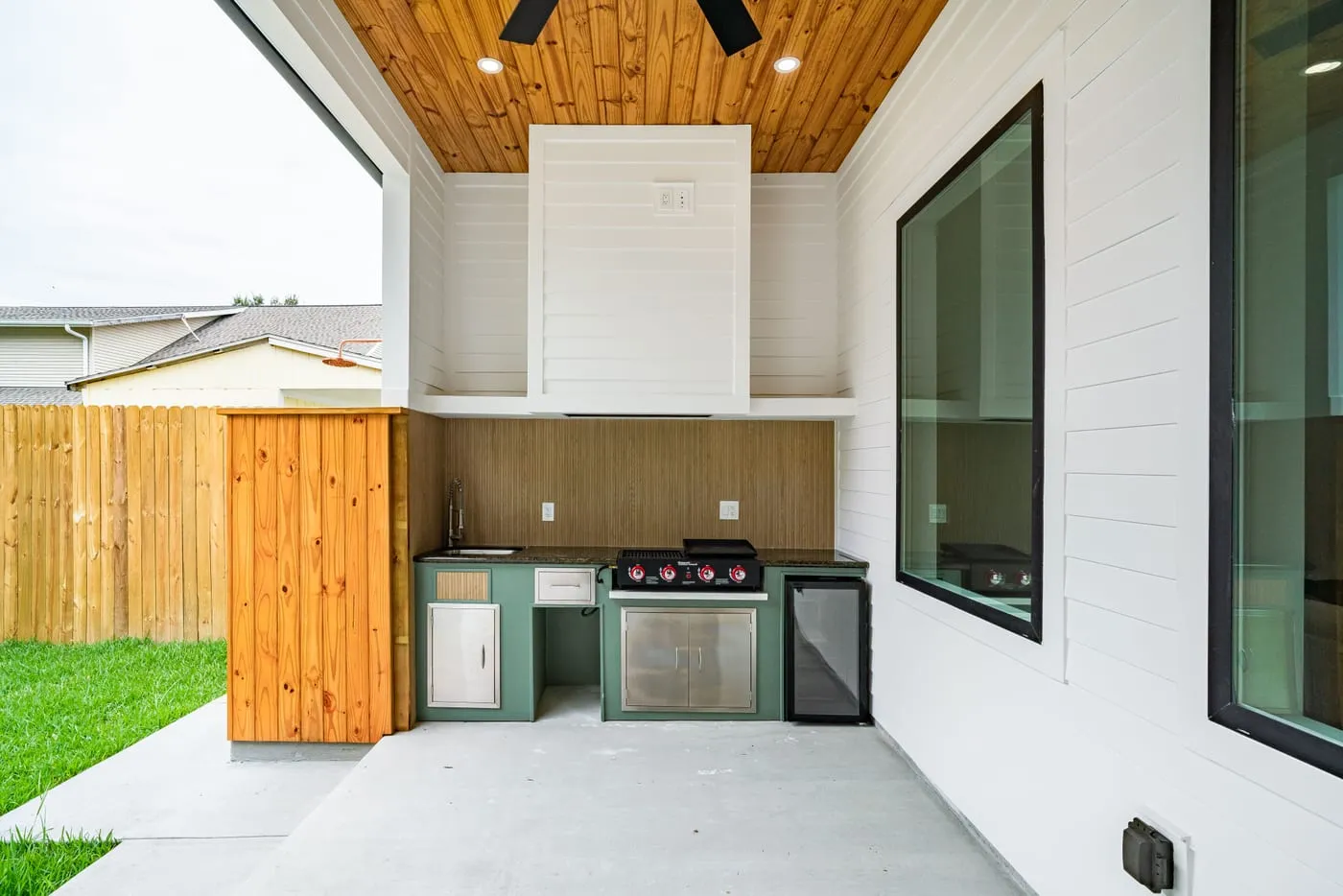
A straight run against a boundary wall or under an existing eave suits narrow yards and renovations where you don’t want to lose lawn space. It’s also the cheapest to plumb and wire because everything sits on one line. An L-shaped layout adds a natural corner for a sink or bar fridge and creates a bit of a divide between the cooking zone and a dining table.
U-shaped kitchens work best in larger backyards where the kitchen effectively becomes an outdoor room in its own right. They cost more because you’re running services around three sides, but they also create the most sociable layout: whoever’s cooking faces the group instead of a wall.
02.Should You Go Built-In or Modular?
Built-in kitchens are constructed on site from masonry, framing, or cabinetry and can’t be moved once finished. Modular outdoor kitchens use pre-fabricated stainless steel or aluminium cabinet units that bolt together, so you can add or reposition pieces later. Modular systems from suppliers like Bunnings and Barbeques Galore start from roughly $3,000 AUD for a small three-module run, versus $8,000 AUD-plus for an equivalent custom-built kitchen. If the kitchen sits under a roof, compare patio and pergola costs per square metre to budget the cover.
Built-in is the better long-term choice if you’re staying in the home and want a finish that matches your existing paving or render. It also tends to add more resale value because it reads as permanent, integrated construction rather than furniture.
Modular suits renters, anyone unsure of their final layout, or people wanting to spread the cost over a few purchases. You buy the BBQ module first, then add a sink module, then a fridge module as budget allows. It’s a genuinely practical way to build an outdoor kitchen in stages without ever having an unfinished-looking gap.
03.What Benchtop Material Actually Survives an Australian Backyard?
Not every stone or laminate marketed for kitchens is rated for outdoor use, and this is the single most common mistake in DIY builds. Porcelain slab and bluestone are the two top performers in Australian outdoor conditions, resisting UV fade, heat, and coastal salt air without ongoing sealing. Granite is a solid third option but needs periodic resealing to resist staining.
Porcelain slab is engineered to handle direct sun and heat without discolouring, and it doesn’t need sealing at all. Bluestone brings a more natural, textured look and has been used on Australian exteriors for well over a century, which tells you something about how it holds up. Both cost roughly $250–$450 AUD per linear metre installed, depending on thickness and edge profile.
Avoid laminate benchtops outdoors entirely: they swell and delaminate within a season once moisture gets under the edges. Untreated concrete looks striking in photos but tends to crack in the temperature swings common across most of Australia unless it’s professionally sealed and reinforced.
04.Which Appliances Are Worth Building In?
A built-in gas BBQ is the obvious centrepiece, but it’s the supporting appliances that turn a kitchen from “a bench with a barbecue” into somewhere people actually want to cook. A quality built-in four-burner BBQ from BeefEater or Weber costs $1,500–$3,500 AUD, and adding a side burner or infrared searing zone typically adds another $400–$800 AUD.
An outdoor fridge keeps drinks and prepped ingredients within reach so nobody’s walking inside every ten minutes. Look specifically for a fridge rated for outdoor temperature swings, not a standard kitchen bar fridge repurposed outside, because the compressors in indoor units struggle once ambient heat climbs past 35°C.
A sink with hot and cold plumbing is a genuine luxury upgrade rather than a necessity, and it’s the appliance most likely to trigger a plumbing permit. Some owners skip it entirely and rely on an outdoor hose tap nearby instead, which is a sensible cost-saving move if your kitchen is close to the main house.
05.Do You Need Council Approval for a Built Outdoor Kitchen?
Most simple, freestanding setups don’t need approval, but permanent built-in structures often do. The NSW Planning Portal notes that gas fittings, plumbing connections, and structural or roofed additions typically require a building permit, and rules vary meaningfully by council and state.
If your kitchen involves running new gas lines, a fixed roof structure, electrical circuits, or a plumbed sink, budget time for a permit application before you commit to a build date. It’s a slower process than most people expect, often several weeks, and starting the gas or electrical work before approval can cause real headaches at resale or insurance time.
Any gas connection for a built-in BBQ must be completed by a licensed gas fitter in every Australian state; this isn’t optional and it isn’t something a general handyman can sign off. Confirm your specific council’s requirements before finalising cabinetry, since retrofitting a permit around finished joinery is far more expensive than planning around it from day one.
06.How Should You Handle Storage and Cabinetry?
Cabinetry choice is where a lot of outdoor kitchens quietly fail within a few years, usually because the material wasn’t actually rated for outdoor exposure. Marine-grade stainless steel and powder-coated aluminium are the only two cabinetry materials genuinely worth installing outdoors in Australia, running roughly $1,000–$2,800 AUD per linear metre installed.
Timber cabinetry looks warm and inviting in showroom photos, but ordinary timber rots and warps within one or two Australian summers of direct weather exposure, even with regular oiling. MDF is worse again; it swells the first time it gets properly wet and never fully recovers its shape.
Marine-grade 316 stainless steel is the gold standard for coastal properties specifically, since standard 304-grade stainless can develop surface rust within a year or two near salt air. Powder-coated aluminium is a lighter, often cheaper alternative for inland properties where salt exposure isn’t a factor. Either way, choose doors and drawers with stainless hinges and slides, not painted steel ones that rust from the inside out.
07.What Ventilation and Overhead Coverage Does an Outdoor Kitchen Need?
Smoke and heat management gets overlooked constantly in outdoor kitchen planning, and it’s the difference between a covered kitchen that’s genuinely usable year-round and one that fills with smoke every time you cook. An outdoor-rated rangehood or extraction fan for a covered kitchen runs roughly $600–$1,800 AUD supplied and installed, on top of the roof structure itself.
If your kitchen sits under a solid roof, whether an existing patio or a new build, you need proper extraction, not just an open gap at the eave line. Heat and smoke pool under a solid roof far more than people expect, especially with a gas BBQ running for an hour or more at a family gathering.
An open pergola with a slatted or louvred roof handles ventilation naturally without any mechanical extraction, which is one reason louvred roof systems have become so popular over solid patio roofs for kitchen zones specifically. If you’re planning the roof structure from scratch, the pergola entertaining ideas guide for Australian homes covers louvred versus fixed roof options in more depth.
08.How Do You Light an Outdoor Kitchen Properly?
Good lighting in an outdoor kitchen needs to do two separate jobs: task lighting bright enough to actually cook by, and softer ambient lighting for the dining side of the space. A dedicated task light or LED strip over the cooking zone from Beacon Lighting typically costs $80–$220 AUD, while a full ambient lighting package for the surrounding area adds another $150–$400 AUD.
Position a bright, outdoor-rated pendant or a linear LED strip directly above the BBQ and prep bench. Warm-white festoon lighting or wall-mounted lanterns around the dining and seating side create the atmosphere without washing out the whole space in the same flat light.
A qualified electrician should install any new outdoor power circuits or fixed lighting, particularly anywhere near a sink or fridge. It’s a small extra cost against the whole build, and it’s the one part of the job you genuinely don’t want to shortcut.
09.What Does a Complete Outdoor Kitchen Cost in Australia?
Total cost swings enormously depending on layout, materials, and how much of the structure already exists. A basic three-module kitchen with an existing patio roof can land under $10,000 AUD, while a full custom build with a new roof structure regularly reaches $30,000–$40,000 AUD. Here’s a rough breakdown by component, based on the ranges covered above.
| Component | Approx. Cost (AUD) |
|---|---|
| Benchtop (porcelain or bluestone, per lin. metre) | $250–$450 |
| Built-in BBQ (four-burner) | $1,500–$3,500 |
| Cabinetry (per lin. metre installed) | $1,000–$2,800 |
| Outdoor bar fridge | $400–$900 |
| Sink and plumbing connection | $800–$2,500 |
| Extraction/rangehood | $600–$1,800 |
| Lighting (task + ambient) | $230–$620 |
| New roof structure (if required) | $5,000–$15,000 |
10.Start Here: Priority Order
| Priority | Action | Approx. Cost |
|---|---|---|
| 1 | Check council requirements for gas, plumbing, and roofing | Free |
| 2 | Choose your layout and confirm bench length available | ~$0 (planning) |
| 3 | Order benchtop and cabinetry in porcelain/bluestone and marine-grade steel | ~$1,250–$3,250/m |
| 4 | Install the BBQ and connect gas via a licensed fitter | ~$1,500–$3,500 |
| 5 | Add lighting and extraction for the cooking zone | ~$830–$2,420 |
An outdoor kitchen is genuinely one of the best investments you can make in an Australian home, both for daily life and for resale. Start with a layout that actually fits your available space, choose materials rated for real outdoor exposure, and get the council and gas fitting sorted before cabinetry goes in. Whether you build a simple modular bench this year or a full custom U-shaped kitchen down the track, the fundamentals in this guide apply either way.
Related reading: