Water is the defining constraint of Australian gardening. Every state has experienced water restrictions in the last decade, and the Bureau of Meteorology’s climate projections show drier conditions ahead for most of southern and eastern Australia. The good news: a drought-tolerant garden is not a compromise — it can be greener, lower-maintenance, and more visually interesting than the thirsty lawn-and-exotics setup it replaces.
This guide covers plant selection, soil preparation, irrigation, and design approaches that work across Australian climate zones. If you’re redesigning the whole backyard, our backyard landscaping ideas for Australian homes covers layout, materials, and structure alongside planting.
01.Why Go Drought-Tolerant in Australia?
The practical case is straightforward. Most Australian capital cities now operate under permanent water conservation rules, and temporary restrictions tighten further during dry spells. Sydney, Melbourne, Brisbane, Perth, and Adelaide have all enforced Stage 2 or higher restrictions within the last five years.
A traditional garden with 50+ square metres of lawn, exotic shrubs, and overhead sprinklers can consume 100,000–150,000 litres of mains water per year. A drought-tolerant garden doing the same job — shade, privacy, colour, usable space — might use 25,000–40,000 litres.
Beyond water bills, there’s the maintenance argument. Native and Mediterranean plants suited to your conditions need less feeding, less pruning, and no mowing. The garden works with the climate instead of fighting it.
02.Native Australian Plants: The Foundation
Australian natives are drought-tolerant by design. They evolved over millions of years in some of the driest soils on earth. Here are the workhorses for a dry-climate garden.
2.1Kangaroo Paw (Anigozanthos)
Kangaroo paw is Western Australia’s floral emblem and one of the showiest drought-tolerant plants available. The tubular flowers come in red, orange, yellow, green, and burgundy, blooming from late spring through summer. They thrive in full sun and sandy, well-drained soil.
Plant in groups of three or five for visual impact. Cut spent flower stems to ground level to encourage repeat flowering. Kangaroo paw handles extended dry spells once established but appreciates a deep soak every two to three weeks during the hottest months.
Where to buy: Bunnings stocks several cultivars ($12–$18 per pot). For rarer varieties, try Australian Native Plants nursery or your local specialist native nursery.
2.2Grevillea
Grevillea is a genus of over 350 species ranging from ground covers to small trees. For drought-tolerant garden beds, the compact shrub varieties are the most useful:
- Grevillea ‘Superb’: 1.5–2m, prolific red-orange flowers, attracts honeyeaters
- Grevillea rosmarinifolia: rosemary-like foliage, pink-red flowers, great for hedging
- Grevillea juniperina: low-spreading, excellent as a groundcover or bank stabiliser
Grevilleas need almost no supplemental watering once established. They prefer well-drained soil and resent heavy clay unless you improve drainage. Most flower year-round in mild climates, giving you colour when everything else has stopped.
2.3Lomandra
Lomandra longifolia (mat rush) is the plant you see in every council median strip, shopping centre carpark, and highway verge — and for good reason. It is nearly indestructible. Lomandra tolerates drought, frost, poor soil, full sun, part shade, salt spray, and foot traffic.
For home gardens, look for the improved cultivars:
- Lomandra ‘Tanika’: compact, fine-leaf, 50–60cm tall, the tidiest option
- Lomandra ‘Nyalla’: broader leaf, slightly larger, good structural plant
- Lomandra ‘Evergreen Baby’: dwarf form, excellent for borders and mass planting
Lomandra works as an edging plant, a filler between larger shrubs, or a lawn replacement when mass-planted. It needs no feeding and handles complete neglect. For more ideas on using natives in smaller spaces, see our guide to small front garden ideas for Australian homes.
2.4Westringia (Coastal Rosemary)
Westringia fruticosa looks remarkably like rosemary and performs a similar role in the garden — hedging, border planting, topiary. It handles salt spray, wind, poor soil, and long dry periods. The grey-green foliage is dense and compact, and the small white or mauve flowers appear most of the year.
Westringia ‘Grey Box’ and ‘Mundi’ are the two most popular garden cultivars. Both stay under 1m without pruning. For a formal low hedge, plant at 40cm spacings and clip twice a year.
2.5Banksia and Callistemon
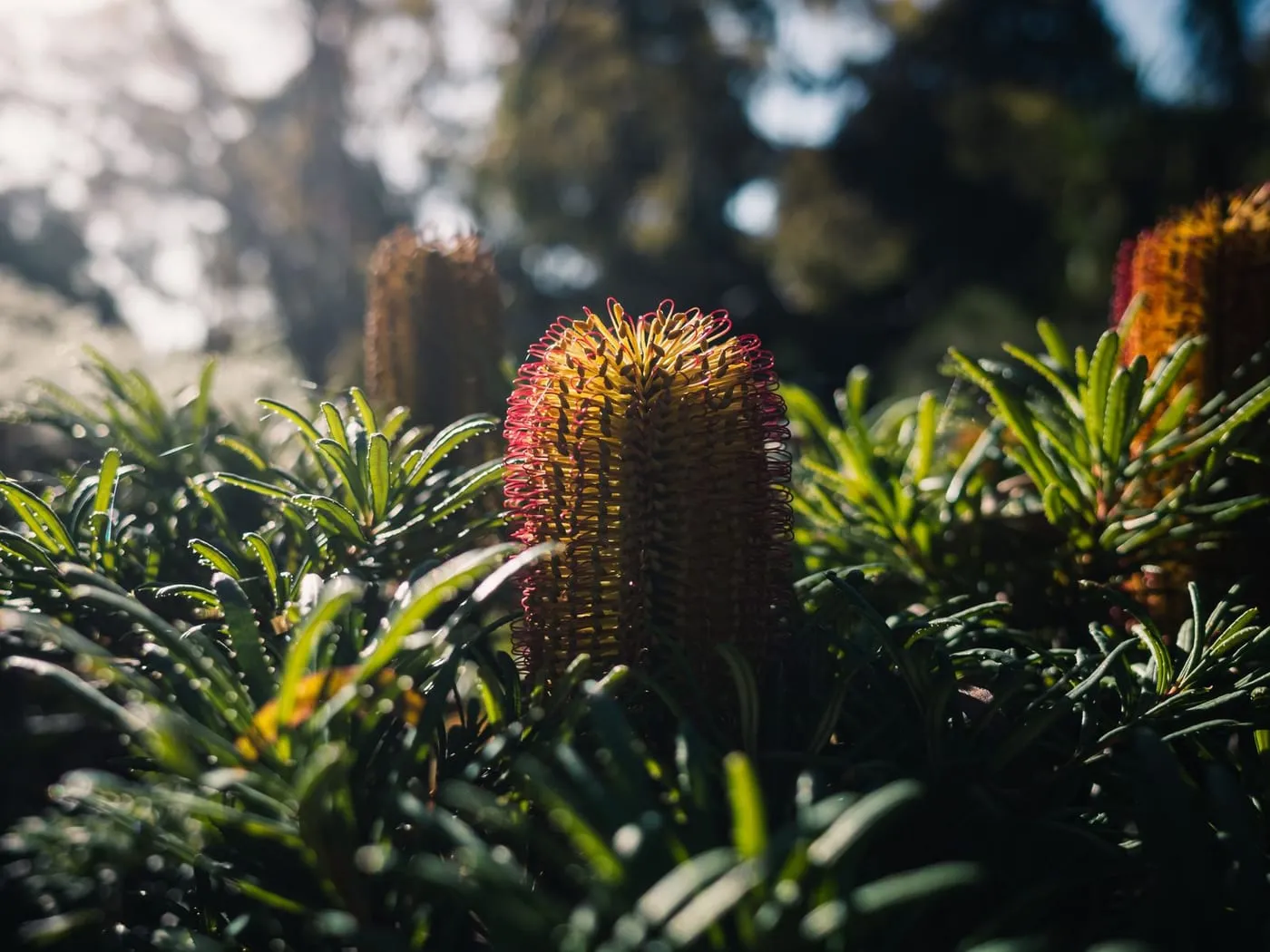
Banksia and bottlebrush (callistemon) are larger structural plants for the back of a garden bed or as feature specimens. Banksia spinulosa (hairpin banksia) grows 1–2m and produces the iconic cylindrical flower spikes that attract birds. Callistemon viminalis (weeping bottlebrush) works as a small shade tree, growing to 4–6m with a graceful weeping form.
Both are extremely drought-hardy once established. Banksia is particularly sensitive to phosphorus — use native-specific fertiliser (low P) if feeding at all.
03.Mediterranean Plants That Thrive in Australia
The Mediterranean climate shares key characteristics with much of southern Australia: hot dry summers, mild wet winters. Plants from that region transplant well here.
3.1Lavender
English lavender (Lavandula angustifolia) and French lavender (Lavandula dentata) both perform well across most of Australia. French lavender is more heat-tolerant and flowers for longer. Plant in full sun, in well-drained soil, and water sparingly once established — overwatering is the main killer.
A row of lavender along a path or driveway costs very little ($6–$10 per plant at Bunnings) and provides fragrance, colour, pollinator habitat, and a natural pest deterrent. Prune hard after flowering to prevent woodiness.
3.2Rosemary
Rosemary is one of the toughest plants you can grow in an Australian garden. It thrives on neglect, handles full sun and reflected heat, and needs watering only during extreme dry spells. Use the prostrate form (Rosmarinus officinalis ‘Prostratus’) as a groundcover or spilling over retaining walls, and the upright form for hedging or culinary harvest.
3.3Olive Trees
A mature olive tree is one of the most beautiful and drought-tolerant feature plants available. They grow slowly, live for centuries, and once established, survive on rainfall alone in most parts of Australia. A 1.5m potted olive from a nursery runs $80–$200 depending on age and variety. For smaller gardens, dwarf cultivars like ‘Arbequina’ stay manageable.
Olives do produce fruit — if that’s a concern (mess on paths, birds), choose a non-fruiting cultivar or accept the annual harvest as a bonus.
04.Mulching: The Biggest Water Saver
Mulch is the single most effective water conservation tool in any garden. A 75mm layer of organic mulch:
- Reduces evaporation from the soil surface dramatically
- Suppresses weed growth (fewer weeds competing for water)
- Insulates root zones against temperature extremes
- Breaks down slowly, adding organic matter to the soil
Best mulch types for Australian gardens:
- Eucalyptus chip mulch: widely available, breaks down at a moderate pace, suits native gardens
- Sugar cane mulch: lighter, breaks down faster, good for vegetable and annual beds
- Pine bark mulch: acidifies soil slightly, good for acid-loving plants, lasts longer
- Pea straw: excellent for vegetable gardens, breaks down quickly, adds nitrogen
How much to buy: A cubic metre of mulch covers roughly 13 square metres at 75mm depth. Most landscape suppliers deliver by the cubic metre ($40–$80 per m³ delivered). Bunnings sells bagged mulch at $8–$12 per bag — cheaper for small areas but expensive at scale.
Key rule: keep mulch 50–100mm away from plant stems and tree trunks to prevent collar rot.
05.Drip Irrigation: Water Where It Counts
Overhead sprinklers lose a significant portion of water to evaporation and wind drift before it reaches the soil. Drip irrigation delivers water directly to the root zone through small emitters, virtually eliminating waste.
A basic drip system for a home garden includes:
- Mainline poly pipe (13mm or 19mm): runs from the tap along the garden bed
- Drip emitters or drip tube: delivers water at 2–4 litres per hour per emitter
- Timer: automates watering schedule (early morning is best — less evaporation)
- Pressure reducer: protects emitters from high mains pressure
Cost: A starter kit covering 20–30 metres of garden bed costs $50–$150 at Bunnings or Irrigation Warehouse. Installation is a weekend DIY job — no plumber required.
Watering schedule for established drought-tolerant plants: Once or twice per week in summer (deep soak), once a fortnight or less in winter. New plantings need more frequent water for the first 6–12 months until roots establish.
Pairing a drip irrigation kit with mulch is the most effective combination — the mulch traps the moisture the drip system delivers, and almost nothing is wasted.
06.Gravel Gardens: Low Water, High Style
Gravel gardens are a design approach borrowed from dry Mediterranean and arid landscapes. The concept: replace water-hungry lawn and garden beds with a gravel or pebble base, then plant drought-tolerant species directly into the gravel.
How to build a gravel garden:
- Remove existing lawn or plants from the area
- Lay landscape fabric to suppress weeds (optional — some gardeners skip this)
- Spread 50–75mm of gravel or decomposed granite over the area
- Cut holes in the fabric and plant directly into the soil beneath
- Mulch around each plant with the same gravel so the bed reads as one surface
Best gravel types:
- Decomposed granite (DG): natural gold-brown colour, compacts slightly, comfortable to walk on
- Tuscan pebble: warm tones, rounded, good for Mediterranean-style gardens
- Blue metal: cooler tone, angular, suits modern or coastal gardens
- River pebble: smooth, natural, works well around water features or dry creek beds
A gravel garden works particularly well in small front gardens where lawn is impractical and maintenance needs to be minimal. Scatter kangaroo paw, lomandra, and lavender through the gravel for a garden that looks designed rather than abandoned.
07.Succulent Gardens
Succulents store water in their leaves, stems, or roots — they are among the most drought-tolerant plants available. In Australian gardens, they work best as:
- Feature plantings in rockeries or raised beds
- Groundcovers on hot, dry slopes and banks
- Container gardens on balconies and courtyards
- Green walls and vertical gardens
Hardy outdoor succulents for Australian conditions include:
- Agave attenuata (foxtail agave): architectural rosettes, grows to 1–1.5m
- Echeveria: compact rosettes in greens, purples, and pinks
- Sedum (stonecrop): excellent groundcover, handles foot traffic
- Kalanchoe: colourful flowers, handles neglect
- Senecio serpens (blue chalk sticks): striking blue-grey foliage, great massed
Succulents need well-drained soil above everything else. In heavy clay, plant in raised beds or mounds with added coarse sand and gravel. Overwatering rots them faster than any drought kills them.
If you’re looking to bring some of that greenery indoors, our guide to indoor plants for coastal Australian homes covers species that handle the same low-maintenance approach inside.
08.Lawn Alternatives That Save Water
Traditional lawn (typically couch, kikuyu, or buffalo grass in Australia) is the single biggest water consumer in most gardens. Replacing even part of your lawn with a drought-tolerant alternative makes a measurable difference.
8.1Native Groundcovers
- Dichondra repens (kidney weed): soft, bright green, handles light foot traffic, grows in sun or shade
- Myoporum parvifolium: creeping native, white flowers, excellent for banks and borders
- Viola hederacea (native violet): shade-tolerant, purple flowers, forms a dense mat
8.2Hard Landscape Alternatives
- Decomposed granite: compacts to a firm, walkable surface, drains well, costs $60–$100 per m³
- Stepping stones through gravel: defines paths without lawn, zero watering
- Timber decking: creates usable outdoor living space without any irrigation
8.3Reduced-Lawn Approach
You don’t have to eliminate lawn entirely. Reducing it to a small functional area (a play space for children, a path between garden beds) and surrounding it with drought-tolerant planting captures most of the water savings while keeping some green underfoot.
If you keep some lawn, choose a drought-tolerant variety. Sir Walter DNA Certified buffalo and TifTuf couch are the two best-performing warm-season grasses for water efficiency in Australian conditions. Both handle extended dry periods and recover quickly after rain.
09.Soil Improvement for Water Retention
Australian soils vary enormously — from heavy clay in parts of Melbourne and Sydney to pure sand along the coast and in Perth. Both extremes create problems for water retention.
9.1Sandy Soil
Sandy soil drains too fast. Water passes straight through before roots can absorb it. To improve:
- Add organic matter: compost, aged manure, or worm castings mixed through the top 200mm
- Bentonite clay: a natural clay product that improves water-holding capacity when mixed into sandy soil. Available at Bunnings ($15–$25 for a 20kg bag)
- Soil wetting agents: products like Seasol Super Soil Wetter help water penetrate hydrophobic sandy soil (common in Perth and coastal areas)
9.2Clay Soil
Clay holds water but drains poorly, creating waterlogged conditions that kill drought-tolerant plants (most prefer dry feet). To improve:
- Gypsum: breaks up heavy clay without changing soil pH. Apply 1kg per square metre and water in
- Coarse sand and compost: mixed through the top 200–300mm improves drainage
- Raised beds: the simplest solution for severely compacted clay — build up rather than digging down
9.3All Soil Types
Regardless of your soil, adding a 50–75mm layer of compost to garden beds before planting, then maintaining 75mm of mulch on top, gives new plants the best possible start. The compost feeds soil biology, the mulch protects it.
10.Water Restrictions by State: What You Need to Know
Each Australian state and territory manages water restrictions differently. Here’s a quick reference:
New South Wales (Sydney Water): Permanent water conservation rules apply at all times. No hosing of hard surfaces, no unattended hoses, sprinklers limited to before 10am and after 4pm. Drip irrigation and hand watering have fewer restrictions.
Victoria (Melbourne Water): Permanent water-saving rules ban hosing paths and driveways. Gardens can be watered with trigger nozzles at any time. Stage restrictions are activated during drought periods.
Queensland (Urban Utilities, Brisbane): Permanent water conservation measures. Sprinklers and irrigation systems may be used between 4pm and 10am. Hand watering is unrestricted.
Western Australia (Water Corporation, Perth): Scheme-water sprinkler rosters apply year-round — you’re assigned specific watering days based on your address. Hand watering and drip irrigation are less restricted.
South Australia (SA Water): Water restriction levels vary by season and dam levels. Drip irrigation is generally the least restricted method across all levels.
The pattern across all states: drip irrigation and hand watering with a trigger nozzle face the fewest restrictions. Overhead sprinklers face the most. Designing your garden around drip irrigation keeps you compliant under almost any restriction level.
11.Putting It All Together: A Sample Drought-Tolerant Garden Plan
Here’s a practical approach for a typical suburban backyard (say 8m × 12m):
Back fence and boundaries: Grevillea or callistemon hedge for privacy and bird habitat. Plant at 1–1.5m spacings. No supplemental water needed after the first year.
Main garden beds: A mix of kangaroo paw, lomandra, and westringia for year-round structure and colour. Add lavender and rosemary for fragrance and culinary use. Mulch all beds to 75mm depth.
Feature tree: A single olive tree or banksia as a focal point. Underplant with a carpet of native violet or dichondra for a green groundcover that needs no mowing.
Entertaining area: Decomposed granite or gravel with stepping stones leading to a seating area. Container succulents and potted herbs for greenery without irrigation infrastructure.
Remaining lawn (if any): A small rectangle of TifTuf couch or Sir Walter buffalo — just enough for kids or pets. Bordered by lomandra or lavender to define the edge.
Irrigation: Drip lines through all planted beds, connected to a battery timer set for two early-morning sessions per week in summer. No sprinklers.
Total estimated cost for plants and materials: $800–$1,500 for a garden this size, depending on plant sizes and whether you DIY or hire help for soil preparation.
12.Quick Maintenance Calendar
Spring: Top up mulch to 75mm. Prune grevillea and westringia lightly after flowering. Plant new additions while soil is still moist.
Summer: Check drip irrigation is flowing correctly. Deep-water new plantings weekly. Established natives should be fine on drip alone.
Autumn: Best time to plant natives — warm soil, incoming winter rain helps roots establish. Add compost to garden beds.
Winter: Reduce or stop irrigation — let rainfall do the work. Prune kangaroo paw stems to ground level if flowering has finished.
13.Related Reading
- Backyard Landscaping Ideas for Australian Homes — layout, structure, and materials for the full backyard
- Small Front Garden Ideas for Australian Homes — drought-tolerant approaches for compact street-facing spaces
- Indoor Plants for Coastal Australian Homes — low-maintenance greenery for inside the house