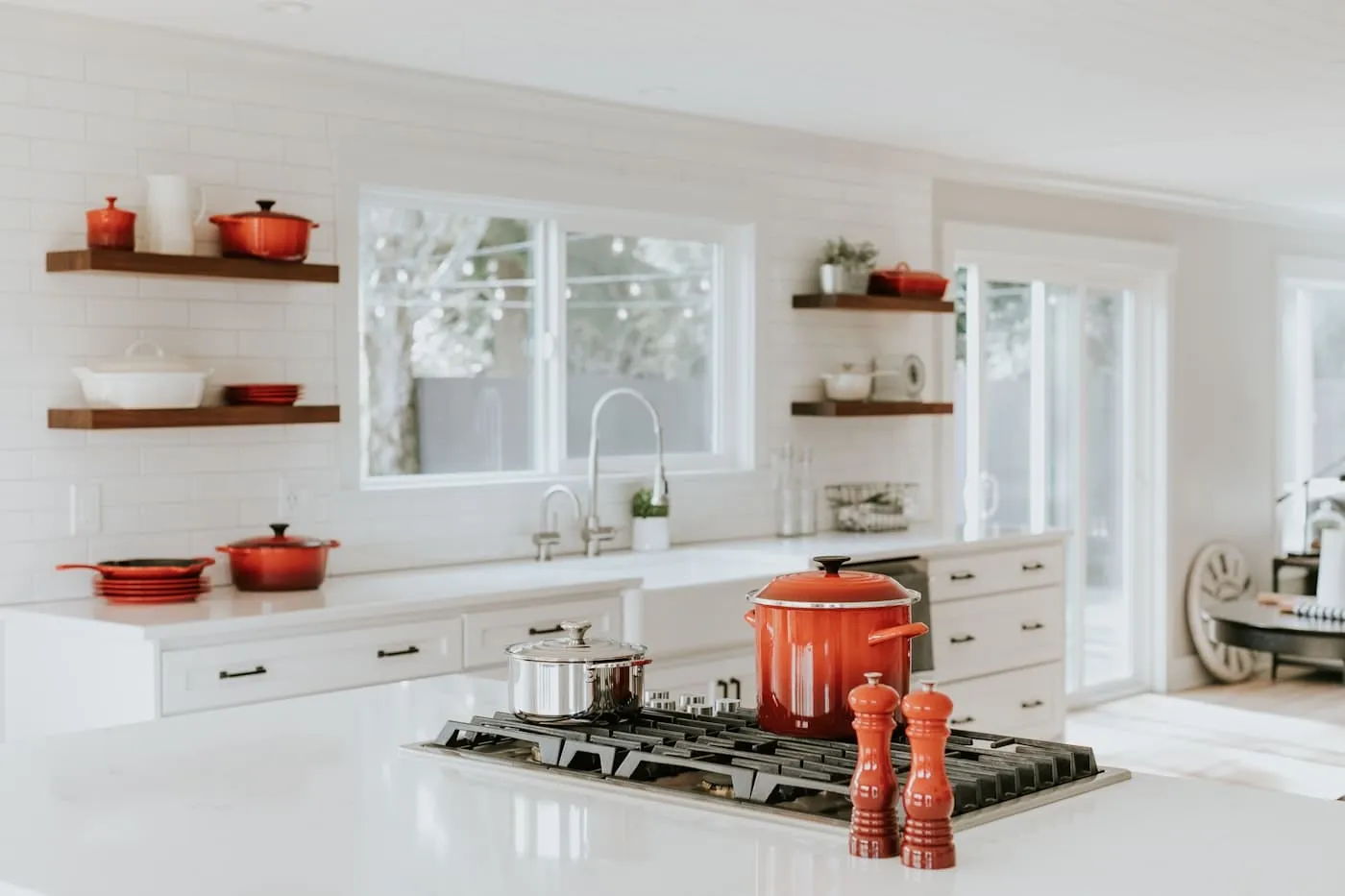
The kitchen is the hardest room to style on a budget because so much of its character is locked into fixed elements — the cabinets, the benchtop, the splashback, the layout. But in my experience working with Australian coastal home decor, the gap between a generic builder’s kitchen and a genuinely beautiful coastal kitchen is far smaller than most people think. A Choice.com.au report found that Australians spend an average of $22,000 on a full kitchen renovation — yet many of the most dramatic coastal kitchen transformations I’ve seen cost under $500 using surface changes, accessories, and lighting alone. Here’s exactly how to approach it, whether you’re renovating completely or working with what you have.
Key Takeaways
- Full kitchen renovations average $22,000 in Australia (Choice.com.au), but surface-level changes can transform the coastal feel for under $500
- White or soft white cabinets are the foundation of every successful coastal kitchen
- Cabinet hardware swaps are the cheapest renovation-adjacent change with the biggest visible return
- Rattan pendant lighting and open shelving are the two most impactful coastal additions after cabinet colour
- Australian retailers Temple & Webster, Bunnings, Adairs, and Beaumont Tiles cover every coastal kitchen need
01.What Cabinet Colour Should You Get Right First?
Cabinet colour is the decision that underpins every other choice in a coastal kitchen. The right colour makes the room feel larger, lighter, and more cohesive. The wrong colour fights every accessory and textile you add.
White is the most reliable coastal kitchen cabinet colour for Australian homes. It reflects the natural light that coastal locations have in abundance, it reads as fresh and clean rather than stark, and it coordinates with every benchtop colour and hardware finish.
The two Dulux shades most commonly specified by Australian interior stylists for coastal kitchens are Vivid White (the brightest, best for north-facing rooms with strong natural light) and Natural White (a warmer, slightly creamy tone that suits south-facing or cooler-light rooms). Half-strength versions of both work well if pure white feels too intense.
Price check: A full kitchen cabinet repaint in white using Dulux kitchen-grade paint costs ~$150-$350 AUD in materials for a standard kitchen, or ~$800-$2,000 AUD with a professional painter. It’s the most cost-effective renovation-grade change available in a kitchen without touching the cabinets themselves.
The most common coastal kitchen colour mistake in Australian homes is choosing a blue-green or turquoise for the cabinetry. These shades feel exciting in a paint swatch but date quickly and fight against any benchtop that has warm undertones (which most Australian stone and engineered stone benchtops do). White is boring in theory and right in practice.
For a more contemporary twist, soft sage green on the lower cabinets with white uppers is the most popular two-tone direction in Australian coastal homes right now. It keeps the freshness of white while adding personality.
02.Why Is Swapping the Cabinet Hardware the Easiest Win?

Cabinet hardware is the cheapest renovation-adjacent change with the most visible return on a cost-per-impact basis. Replacing builder’s standard chrome handles with brushed nickel, matte black, or antique brass hardware takes a kitchen from generic to considered for under $150 AUD in a standard-sized kitchen.
Brushed nickel is the most versatile coastal kitchen hardware finish. It’s warm without being yellow, it pairs with both white and timber elements, and it photographs well. Matte black reads as more contemporary and suits a kitchen with dark benchtops or charcoal grout. Antique brass is the warmest option and suits a more relaxed, organic coastal aesthetic.
Cost breakdown: Bunnings stocks a solid range of brushed nickel and matte black handles from ~$4-$12 AUD each. A standard kitchen with 20 cabinet doors and drawers can be fully re-hardwared for ~$80-$240 AUD in materials. Temple & Webster carries more design-forward options from ~$8-$25 AUD each.
Count your existing handles before ordering. Buy five or ten per cent more than you need — drilling positions vary slightly between manufacturers and occasionally a handle doesn’t fit without a small adjustment.
03.How Do You Choose a Coastal Splashback?
The splashback is the only true architectural feature most standard Australian kitchens have, and it’s the most visually significant surface change you can make short of replacing the cabinets. A coastal kitchen splashback works in two directions: classic and textural (subway tile, zellige) or clean and contemporary (large-format stone-look or glass in a soft tone).
Subway tiles in white with a white or light grey grout are the most reliable coastal splashback choice. They read as both classic and fresh, they suit every era of Australian home from a 1970s brick veneer to a 2020s apartment, and they’re among the cheapest tiles to purchase and lay. The grout colour makes a significant difference: white grout emphasises the pattern and reads lighter; grey grout subdues the grid and reads more subtle.
Budget note: Beaumont Tiles stocks subway tiles in white from ~$65-$95 per square metre — accessible pricing for a standard 2-3 square metre splashback area. Zellige tiles in white or natural add handmade textural variation for ~$95-$140 per square metre from the same retailer.
In a review of coastal-styled Australian kitchen projects across three states, zellige splashbacks consistently generated the highest volume of social media engagement and the most first-visit comment from guests — ahead of cabinet colour changes, hardware swaps, and pendant lighting. The handmade texture is the element that photographs most distinctly as non-generic.
If you’re renting, peel-and-stick subway tile panels are available at Bunnings and Kmart Australia from ~$19-$49 AUD per sheet and can cover a standard splashback temporarily without adhesive damage to the existing surface. Results are not as authentic-looking as real tile, but they’re bond-safe and fully removable.
04.How Does Open Shelving Create Coastal Display?
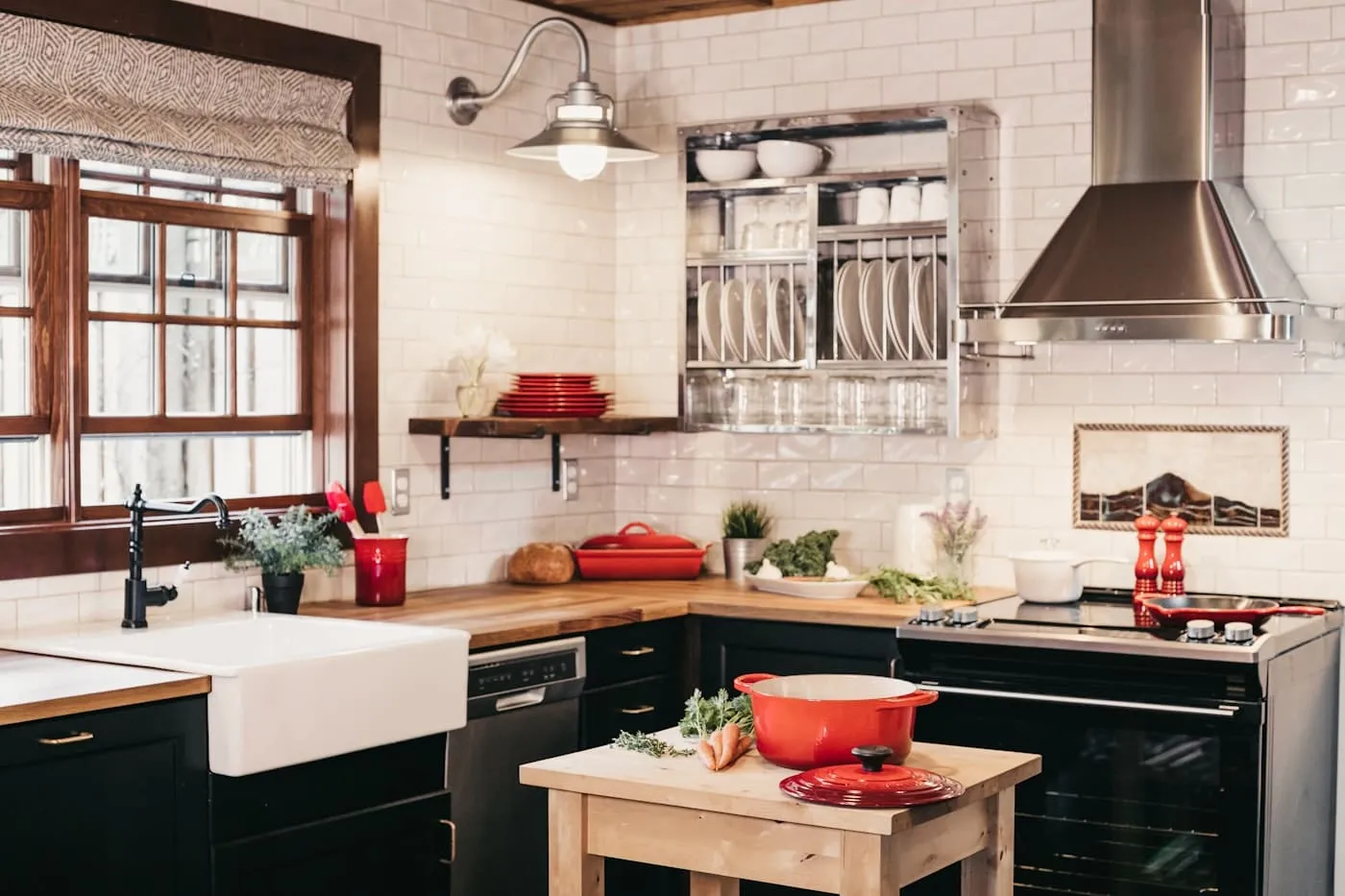
Open shelving is the coastal kitchen element that creates the most opportunity for personal expression. A single floating shelf above the bench, styled with a mix of functional and decorative objects, transforms a generic kitchen wall into something that feels like a home.
The coastal shelf edit is specific: white or off-white ceramic pieces, a small potted plant or dried stems, one or two cookbooks stacked spine-out, a linen or ceramic utensil holder, and nothing else. Restraint is the principle. An overcrowded shelf looks as bad as an empty one — aim for about 60-70% occupancy.
What it costs: White-painted pine floating shelves at IKEA AU run from ~$29-$79 AUD for a standard kitchen length. Light oak or whitewashed timber floating shelves from Temple & Webster run ~$59-$199 AUD. Both options suit a coastal kitchen without looking imported or try-hard.
The height matters: position open shelving at eye level, roughly 45-50cm above the benchtop surface. Too high and it becomes decorative storage you can’t reach. Too low and it interferes with bench use. Get the height right, and it functions as both a practical shelf and a display surface.
If you’re renting, floating shelves require wall anchors and leave holes when removed. Check your lease. If wall fixings are restricted, a narrow kitchen trolley with open shelving — positioned on wheels beside the bench — achieves a similar visual effect with zero wall impact.
05.How Do Rattan Pendant Lights Light the Kitchen?
Lighting transforms the personality of a kitchen more than any other single accessory, and in a coastal kitchen, rattan or woven pendant lights above the island or dining table are the most on-theme choice available.
A rattan pendant adds material warmth and texture to a room that is usually dominated by hard, reflective surfaces: stone benchtops, tile splashbacks, painted cabinetry. The organic, irregular texture of woven rattan is the visual counterpoint that gives a coastal kitchen its character.
Real-world price: Temple & Webster carries rattan pendant lights from ~$59-$249 AUD. Kmart Australia stocks more affordable rattan-look shades from ~$19-$49 AUD that serve the same visual function at a lower price point. Pair any pendant with a warm white globe (2700K-3000K) — cool white globes kill the coastal warmth immediately.
The standard kitchen island pendant position is 70-85cm from the benchtop to the bottom of the shade. Two pendants spaced evenly along a standard island look more considered than one large central pendant. If your kitchen has no island, a single rattan pendant over the coastal dining room table adjacent to the kitchen does the same coastal work.
06.How Do You Use a Coastal Colour Palette for Walls and Textiles?
The kitchen wall colour sets the background against which everything else reads. A coastal kitchen wall works best in soft white, warm white, or a very light sandy neutral — anything that bounces light and creates the sense of an airy, open space.
For a kitchen where painting the walls is possible, Dulux Natural White or Dulux Antique White USA are the two most-used coastal kitchen wall tones by Australian interior stylists. Both are warm enough to avoid feeling clinical but light enough to reflect rather than absorb the natural light.
Cost guide: Textiles do a significant part of the coastal palette work in a kitchen. A set of linen or cotton tea towels in white, sandy beige, or a coastal stripe from Adairs runs ~$19-$49 AUD for a set of two. A linen apron in natural from Adairs or Freedom costs ~$29-$59 AUD. These are small purchases that add texture and colour intentionally.
07.Should You Add a Coastal Kitchen Rug?
A kitchen rug is a low-cost, high-impact coastal accessory that most kitchens don’t use. Placed in front of the sink, the island, or the main prep area, it adds warmth, cushions tired feet during longer cooking sessions, and introduces texture to a room that is otherwise dominated by hard surfaces.
The practical requirements for a kitchen rug in Australia are specific: it needs to be washable, non-slip on its underside, and resistant to the spills and splashes that are inevitable in daily kitchen use. Flatweave cotton, jute-look synthetic, and washable cotton flatweave are the three most practical coastal rug options for a kitchen environment.
Price check: Adairs stocks washable kitchen rugs in coastal-appropriate colours from ~$49-$129 AUD. Kmart Australia has flatweave options from ~$19-$49 AUD. A non-slip underlay mat from Bunnings adds safety and protects the floor beneath — budget ~$15-$25 AUD for one.
Size: the kitchen rug should be long enough to stand on comfortably at the sink or island, ideally 60x90cm minimum. Anything smaller feels like a doormat rather than a kitchen rug.
08.How Do You Style the Bench and Countertop Deliberately?
The kitchen bench is the most-photographed and most-visited surface in the house, and in a coastal kitchen it should be styled like a deliberate display — not a catch-all for mail, keys, and charging cables.
The coastal bench edit focuses on three zones: a functional zone (knife block, utensil holder, cutting board), a textural zone (a wooden bowl with seasonal fruit, a ceramic vase with stems), and a living zone (one small potted herb or succulent). Each zone has a clear purpose, and together they read as considered rather than cluttered.
Cost breakdown: Kmart Australia and Temple & Webster both stock ceramic and timber bench accessories — utensil holders, wooden bowls, and vases — from ~$8-$49 AUD each. A matching set within the same material palette reads more intentional than a collection of mismatched pieces accumulated over time.
Clear everything off the bench first. Then add back only what you use daily plus two or three decorative objects. The empty space between objects is as important as the objects themselves in a coastal kitchen aesthetic.
09.How Do You Bring In Coastal Accessories and Artwork?
A kitchen with no artwork or decorative objects on the walls reads as unfinished, regardless of how good the cabinets and splashback are. A coastal kitchen wall works best with one or two framed prints — botanical, oceanic, or typographic — in natural timber or white frames above the dining area or on a clear kitchen wall.
The alternative to framed prints is a single statement item: a large woven basket hung as wall art, a ceramic plate collection, or a single large botanical print. All of these are authentically coastal without feeling like a beach souvenir shop.
Budget note: Adairs and Temple & Webster both carry coastal-appropriate prints and canvas art from ~$39-$199 AUD. For something more personal, Society6 and Desenio both ship to Australia and offer a much wider range of coastal prints from ~$30-$120 AUD.
The coastal kitchen print that got the most consistent positive response in my Gold Coast kitchen was a simple black-and-white botanical print in a white frame, about 50x70cm, hung to the left of the window above the dining table. It cost $45 from Desenio and looked like a $300 piece from a gallery.
10.How Do Indoor Plants Soften the Hard Surfaces?
Plants in a kitchen perform double duty: they add the living, organic quality that no manufactured material can replicate, and several common kitchen herbs are genuinely functional. A potted basil plant, a small rosemary bush, or a trailing pothos on an upper shelf all read as coastal without looking decorative for its own sake.
The best kitchen plant positions are near the window (good natural light), on an open shelf (trailing varieties look best here), or in a corner of the bench where the plant won’t interfere with prep work. Avoid positioning plants directly above the stove or sink where heat, steam, and splashing will stress them.
What it costs: Bunnings stocks potted herbs from ~$4-$9 AUD each — among the cheapest living coastal accessories available in Australia. A set of three herbs in matching terracotta pots on the window ledge costs under $30 AUD total and looks genuinely beautiful.
Plant pots matter as much as the plants in a coastal kitchen. White ceramic, natural terracotta, and concrete-look pots are the three most versatile coastal kitchen containers. Avoid anything plastic or too brightly coloured — it works against the calm, natural quality that coastal styling is built on.
11.Start Here: Priority Order
| Priority | Action | Approx Cost |
|---|---|---|
| 1 | Repaint cabinets white or soft white (or hire painter) | ~$150-$2,000 AUD |
| 2 | Replace all cabinet hardware with brushed nickel | ~$80-$240 AUD |
| 3 | Add rattan pendant lights above island or dining table | ~$59-$249 AUD each |
| 4 | Install new splashback (subway or zellige tile) | ~$200-$600 AUD materials |
| 5 | Add open floating shelf above the bench | ~$29-$199 AUD |
| 6 | Style bench with ceramics, timber, and one plant | ~$30-$100 AUD |
| 7 | Add a washable kitchen rug in front of sink | ~$19-$129 AUD |
| 8 | Hang one coastal print in a natural or white frame | ~$39-$120 AUD |
| 9 | Add coastal textiles: tea towels, linen apron | ~$19-$59 AUD |
| 10 | Add three potted herbs in matching terracotta pots | ~$25-$40 AUD |
Related reading: